/ ACTING FOUNDATION /
Acting Foundations A 12-week foundation course covering body awareness, breathing, voice, emotional expression and script analysis. Develop monologues and two-person scenes, then put them into practice on camera and in audition filming.
/ CURRICULUM /
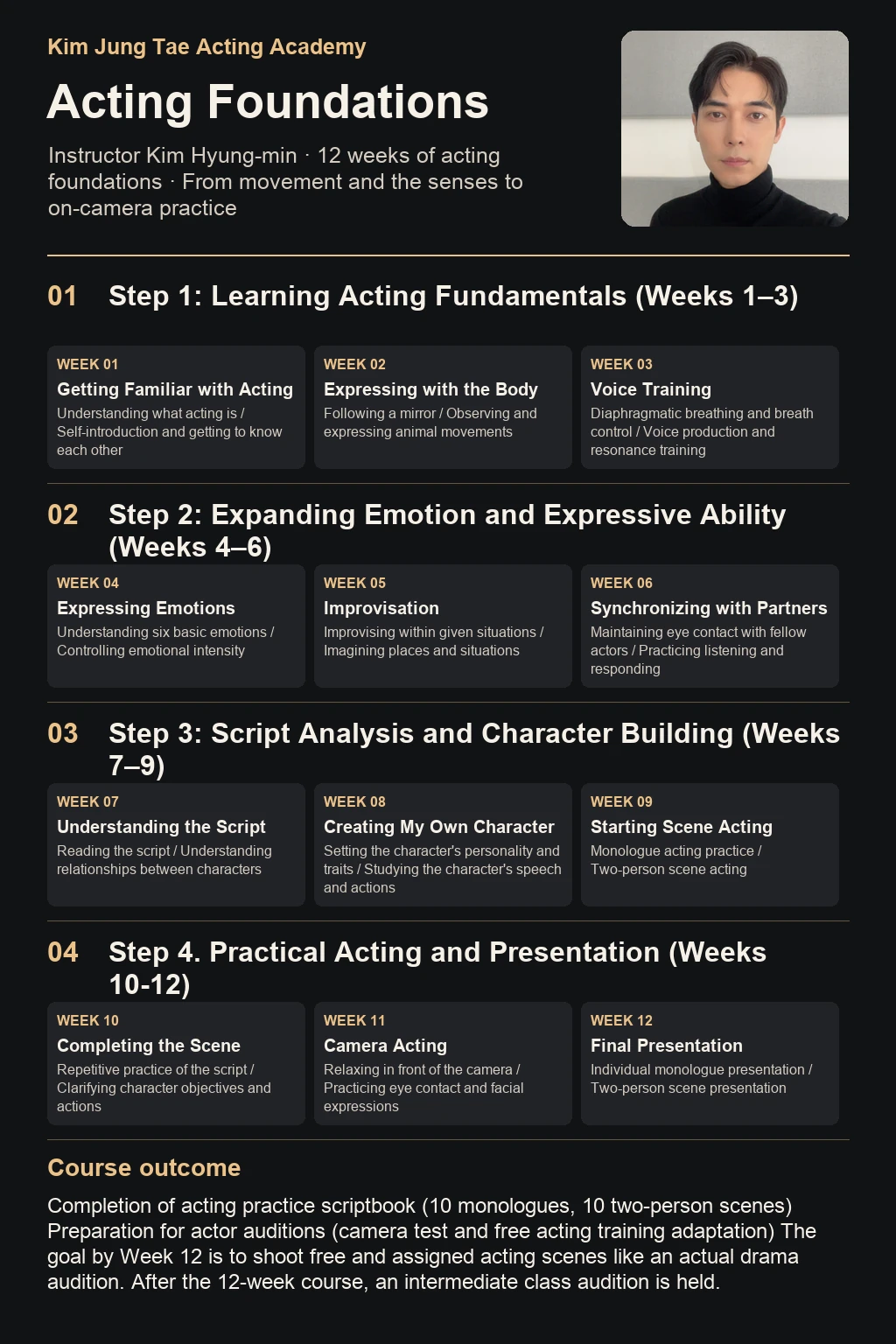
From Your First Acting Class to Auditions Instructor Kim Hyung-min · 12 weeks of acting foundations · From movement and the senses to on-camera practice
Select the poster to view it at full size. View original curriculum poster ↗ Educational Goals To freely utilize body and senses To learn basics of voice and pronunciation, and breathing To enhance expressive ability using emotions and imagination To train interaction and response with other actors To analyze scripts and construct characters To gain practical experience through final scene presentation Step 1: Learning Acting Fundamentals (Weeks 1–3) Week 1 · Getting Familiar with Acting Understanding what acting is Self-introduction and getting to know each other Releasing body tension Moving freely within the space Expressing situations without emotions Week 2 · Expressing with the Body Following a mirror Observing and expressing animal movements Imagination training using the five senses Conveying situations through actions Week 3 · Voice Training Diaphragmatic breathing and breath control Voice production and resonance training Accurate pronunciation of vowels and consonants Expressing the same sentence with various emotions Step 2: Expanding Emotion and Expressive Ability (Weeks 4–6) Week 4 · Expressing Emotions Understanding six basic emotions Controlling emotional intensity Expressing emotions using facial expressions and body Acting one line with multiple emotions Week 5 · Improvisation Improvising within given situations Imagining places and situations Creating everyday life scenarios Pair improvisation Week 6 · Synchronizing with Partners Maintaining eye contact with fellow actors Practicing listening and responding Conveying emotions without words Responding immediately to partner’s actions Step 3: Script Analysis and Character Building (Weeks 7–9) Week 7 · Understanding the Script Reading the script Understanding relationships between characters Understanding the scene's situation and events Finding the character's objectives Understanding the hidden meaning of lines Week 8 · Creating My Own Character Setting the character's personality and traits Studying the character's speech and actions Finding the character's emotional changes Setting character goals and obstacles Week 9 · Starting Scene Acting Monologue acting practice Two-person scene acting Memorizing lines and blocking Connecting the flow of emotions Acting in front of the camera Step 4. Practical Acting and Presentation (Weeks 10-12) Week 10 · Completing the Scene Repetitive practice of the script Clarifying character objectives and actions Synchronizing with co-actors Completing the beginning and end of the scene Week 11 · Camera Acting Relaxing in front of the camera Practicing eye contact and facial expressions Delivering lines naturally Filming the same scene multiple times Reviewing and editing filmed footage Week 12 · Final Presentation Individual monologue presentation Two-person scene presentation Camera test Instructor feedback Review of 12-week growth process Student's personal completion goals Completion of acting practice scriptbook (10 monologues, 10 two-person scenes) Preparation for actor auditions (camera test and free acting training adaptation) The goal by Week 12 is to shoot free and assigned acting scenes like an actual drama audition. After the 12-week course, an intermediate class audition is held.